Navigation
Art of Different Perceptions
Three painters and their audience in the 1950s and 1960s
Carl Ludwig Loreck (1898–1991), Rolf Cavael (1898–1979), Hans Otto Buchner (1909–1972)
11 February to 7 June 2026
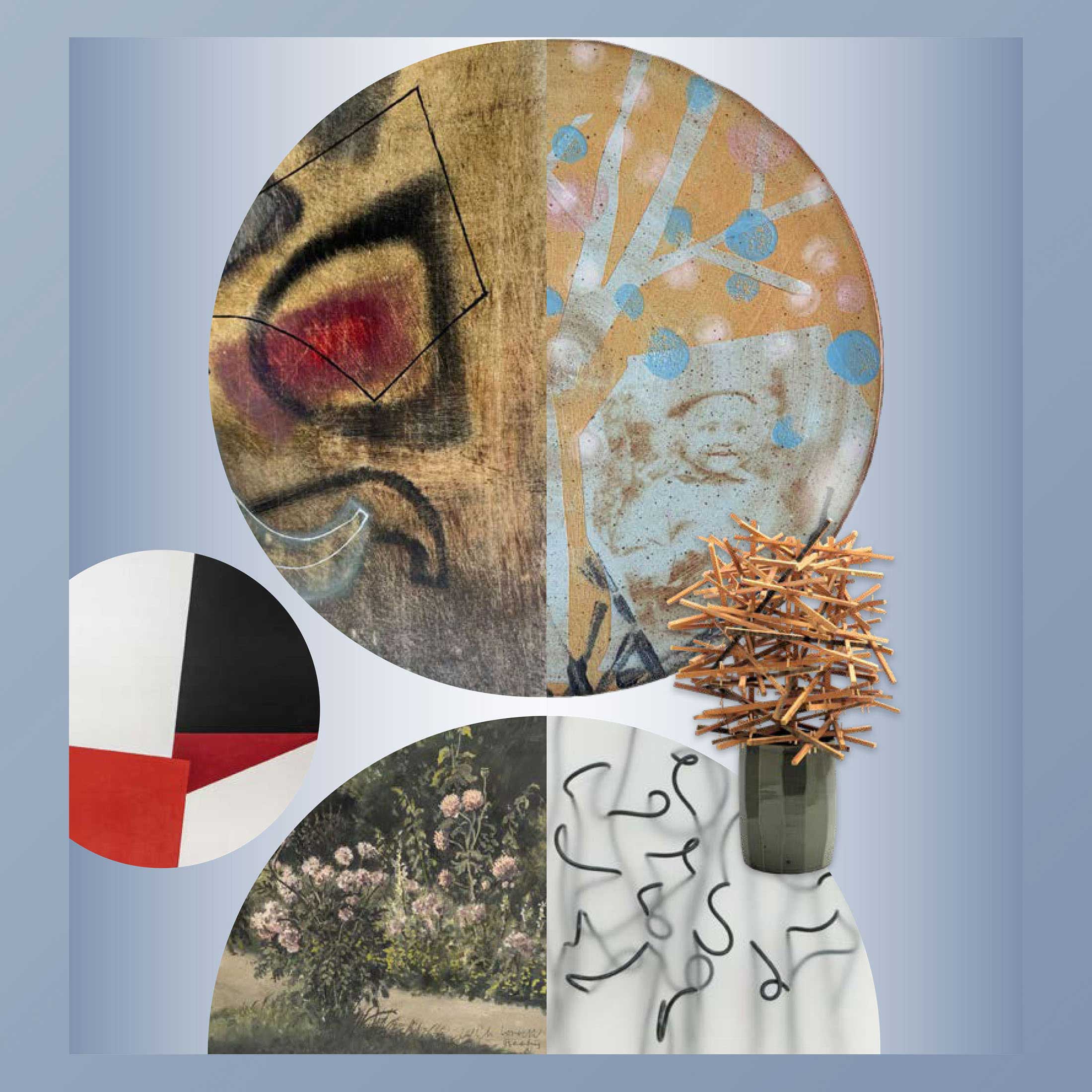
The exhibition presents over 120 works that trace three life paths and three different artistic approaches, with a focus on the post-war period and the 1950s and 1960s. The works and biographies of Carl Ludwig Loreck, Rolf Cavael, and Hans-Otto Buchner invite reflection—precisely through their differences—on art, the art world, and also on collectors and audiences: What does art tell us about time and society when romantic natural idyll, radical abstraction, and the freedom not to commit to a single style all find their own audiences in parallel?
Thinking About Things – Art Interventions II
11 February to 8 November 2026
Three artists—the ceramist Stephanie Borchardt (Garmisch-Partenkirchen), designer and master carpenter Christoph Leuner (Garmisch-Partenkirchen), and painter and poet Günter Nosch (Weilheim)—enter into an engaging dialogue with the museum’s collection. Their shared theme is reflection on the meaning and form of objects.
The simultaneity of the non-simultaneous
Carl Ludwig Loreck painted landscapes in a deeply nature-fascinated, romantic-lyrical style. His oeuvre comprises more than 3,000 oil paintings and watercolours, almost all of which he sold, largely without participating in the contemporary art world. Numerous collectors purchased his works directly from his studio. To this day, many “Loreck” paintings hang in private homes not only in the Garmisch-Partenkirchen district. During his lifetime, he was a respected and highly successful painter.
Rolf Cavael’s work, by contrast, was shaped by abstraction from the very beginning. During the National Socialist period, he was banned from exhibiting and was only able to paint in secret. Early on, he corresponded with Kandinsky and later became a co-founder of the artist group ZEN 49. He is the one among the three painters who belonged to the artistic avant-garde, most strongly embodied the art world’s zeitgeist, and remains the most widely known beyond the region today.
Hans-Otto Buchner worked for a long time as a commercial graphic designer, like Cavael, and only came to Garmisch-Partenkirchen after the end of the Second World War. Unlike the other two painters, he expressed his motifs in a wide variety of styles, techniques, and materials. He deliberately avoided committing to any single style, instead seeking artistic adventure through constant transformation during his numerous journeys to the south. Only a few years before his death did he arrive at a distinctive personal style.
Reflecting on Art
Although the works of Carl Ludwig Loreck, Rolf Cavael, and Hans-Buchner were very different, all three created high-quality paintings and works on paper. All three were also artists in the deepest sense of the word. For them, artistic creation was a vocation, a source of vitality, an inner necessity. After the rupture of the Nazi era and the Second World War, they worked as freelance artists in the young Federal Republic of Germany. They lived for long periods of their lives in Garmisch-Partenkirchen. All three found their niche and their own audience.
Nevertheless, the answers each of them gives to questions about art and the art world of their time differ significantly: What makes artworks fascinating? How important is the artist’s personality in this regard? What does an artist’s life in 20th-century Germany look like? What kind of art did people buy in the post-war period and hang in their private homes? Does art make its creators and its audience “happy”?
The exhibition offers an overview of the three artists’ work and highlights their individual positions. Through this juxtaposition, their overall oeuvres gain new depth in their distinctiveness. They stand almost paradigmatically for the different developments in German art after 1945.
Thinking about Things – Art Interventions II
11 February to 8 November 2026
Three artists—the ceramist Stephanie Borchardt (Garmisch-Partenkirchen), designer and master carpenter Christoph Leuner (Garmisch-Partenkirchen), and painter and poet Günter Nosch (Weilheim)—enter into an engaging dialogue with the museum’s collection. Their shared theme is reflection on the meaning and form of objects.
Günter Nosch calls his project “Duden Dichten” (“Poetry by Dictionary”). For this, around 50 permanently displayed objects from the collection are given playful new titles and seemingly meaningful explanations in the concise style of a dictionary entry. Beyond the joy of wordplay, the aim is to turn our perception upside down. Selected works on glass, wood, and cardboard are simultaneously placed in relation to the collection. Christoph Leuner’s sculptural vessels—he himself refers to them as “hollow bodies”—enter into dialogue with the historical collection in terms of form and function. His work explores volume, shape, materiality, craftsmanship, and, not least, the meaning of objects. For 35 years, he has been probing the boundaries between the visible and the hidden, making the juxtaposition with historical objects particularly compelling.
Ceramist Stephanie Borchardt expands and reflects the museum’s historical holdings of utilitarian vessels through her stoneware ceramics. Her works draw on historical forms and craft techniques, while at the same time remaining clearly individual and contemporary. For this exhibition, she developed a dedicated series incorporating photographic elements fired into clay.
The interventions disrupt habitual ways of seeing and open up new associations—offering a fresh perspective on historical objects and enabling a dialogical museum experience throughout the entire year.

Museum Werdenfels e.V.
Ludwigstraße 47
82467 Garmisch-Partenkirchen
08821 - 751710
info@museum-werdenfels.de
Directions
Opening Hours
Tuesday to Sunday: 10 am to 5 pm.
Also open on Mondays if they are public holidays.
Tickets
Admission from €4.50
Parking in the underground garage is free for 2 hours
More information